Calorie Tracking Burnout: Why 90% of Users Quit Logging by Week 3
If you've ever stopped logging your meals, don't blame your willpower. Blame the bad product design of legacy calorie counting interfaces.

Ajay Rathore
April 20, 2026 • 6 min read
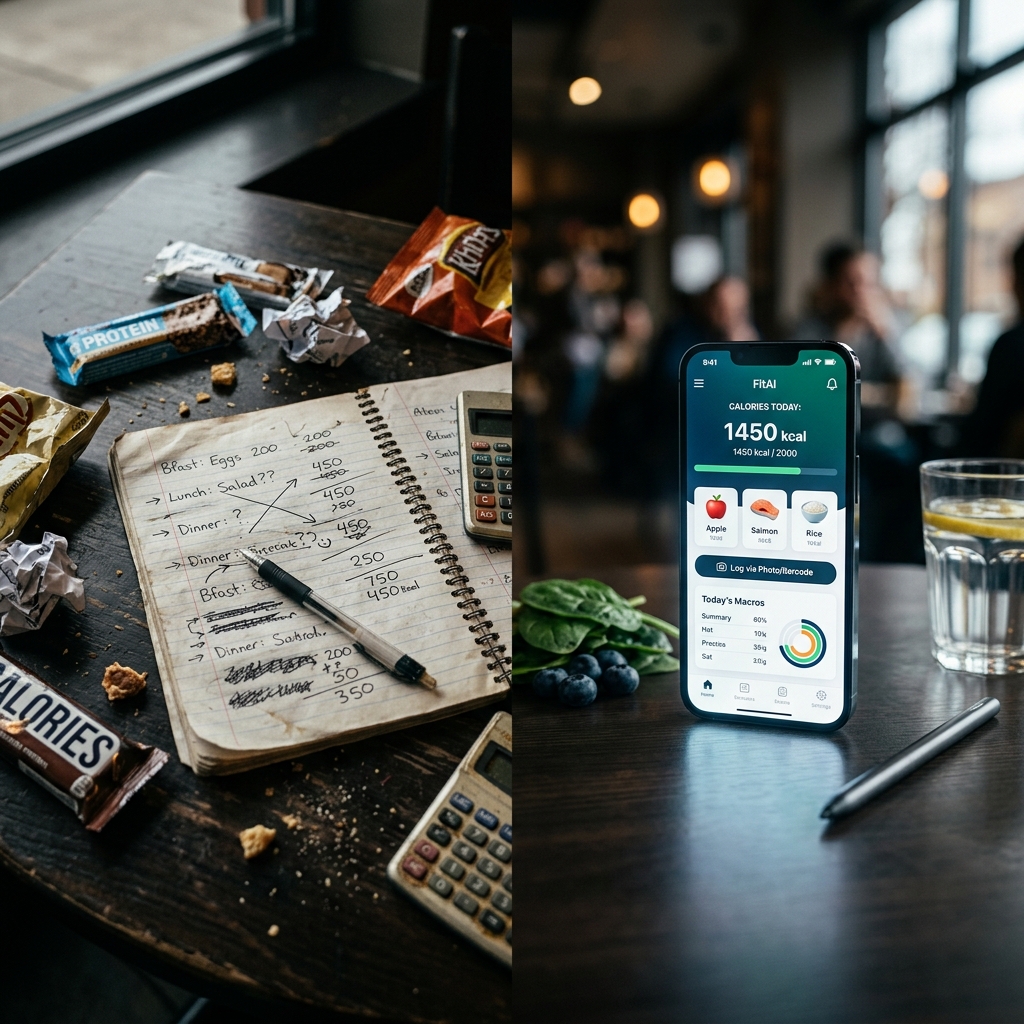
We have all been there. You wake up on a Monday morning filled with motivation. You download a calorie counting app, set a target deficit, and swear that this is the time you'll stick to it.
For the first few days, you log everything: breakfast, snacks, coffee, dinner. But by day ten, the routine starts to feel heavy. By day fifteen, you skip logging dinner because you went out with friends. By day twenty, the app sits unused in a folder—uninstalled a week later.
1. The Awful Retention Rates of Fitness Apps
Industry statistics reveal a stark truth: **over 90% of active users quit logging their food in traditional apps within the first three weeks.**
When an industry has a 90% failure rate, the problem isn't the users' discipline—it is the underlying interface. Legacy tracking apps are designed as database query portals, forcing you to act like a data entry clerk before every single bite of food.
2. Database Decision Fatigue
Every time you manually log a meal, you are forced to make a series of micro-decisions:
- Is this banana a "medium" (7-inch) or a "large" (8-inch) banana?
- Should I choose the database entry with 120 calories or the one with 180 calories?
- How many grams of butter did the chef use in this scrambled egg?
These questions pile up. Staring at a search list of 30 identical-sounding food items trying to decide which one is "correct" drains your mental battery. Over time, this database decision fatigue builds up until logging feels like an active chore.
3. The "Homework Chore" Interruption
Eating is meant to be a relaxing, sensory, social experience. Manual logging actively disrupts that.
Pulling out a scale, weighing food containers, looking up items, and inputting numbers turns a peaceful dinner into a dry quantitative audit. It adds psychological friction, inducing feelings of anxiety and hyper-fixation. When tracking feels like strict homework, it is only a matter of time before you rebel and quit.
4. How Removing Friction Changes the Game
To create a tracking system that people actually stick with, we have to reduce the cognitive friction to absolute zero.
That is the foundational philosophy behind **Nutraize**.
Instead of searching, typing, choosing, and adjusting, you simply **snap a quick photo** before eating. The computer vision handles all the calculations, portion estimations, and database tagging in the background. The action takes under three seconds and leaves your focus completely free to enjoy your meal.
5. Habit Loops: Effortless Logging is Consistent Logging
In his best-selling book *Atomic Habits*, James Clear outlines that to build a sustainable habit, you must **make it obvious, attractive, easy, and satisfying.**
Manual vs. AI Habit Loop:
- Manual: Eat Meal → Weigh food, search database, scroll options, log macros (10 minutes of friction) → Habit fails.
- AI Visual: Eat Meal → Quick 3-second camera snap → AI updates dashboard automatically → Habit succeeds.
If you have burned out on calorie tracking before, know that your willpower wasn't the issue. Outdated interface design was. By letting AI do the heavy lifting, nutrition logging transforms from a chore into a seamless part of your daily rhythm.
Stop the Logging Burnout
Nutraize eliminates the pain of database entry. Snap a picture of your food, and log your calories in seconds. Join the frictionless tracking revolution.
