Can You Trust AI for Weight Loss? The Real Math Behind AI Portion Estimation
Is an AI photo estimate actually accurate enough to get you in shape? Let's look at the math, the science, and the cold hard data.

Ajay Rathore
March 28, 2026 • 7 min read
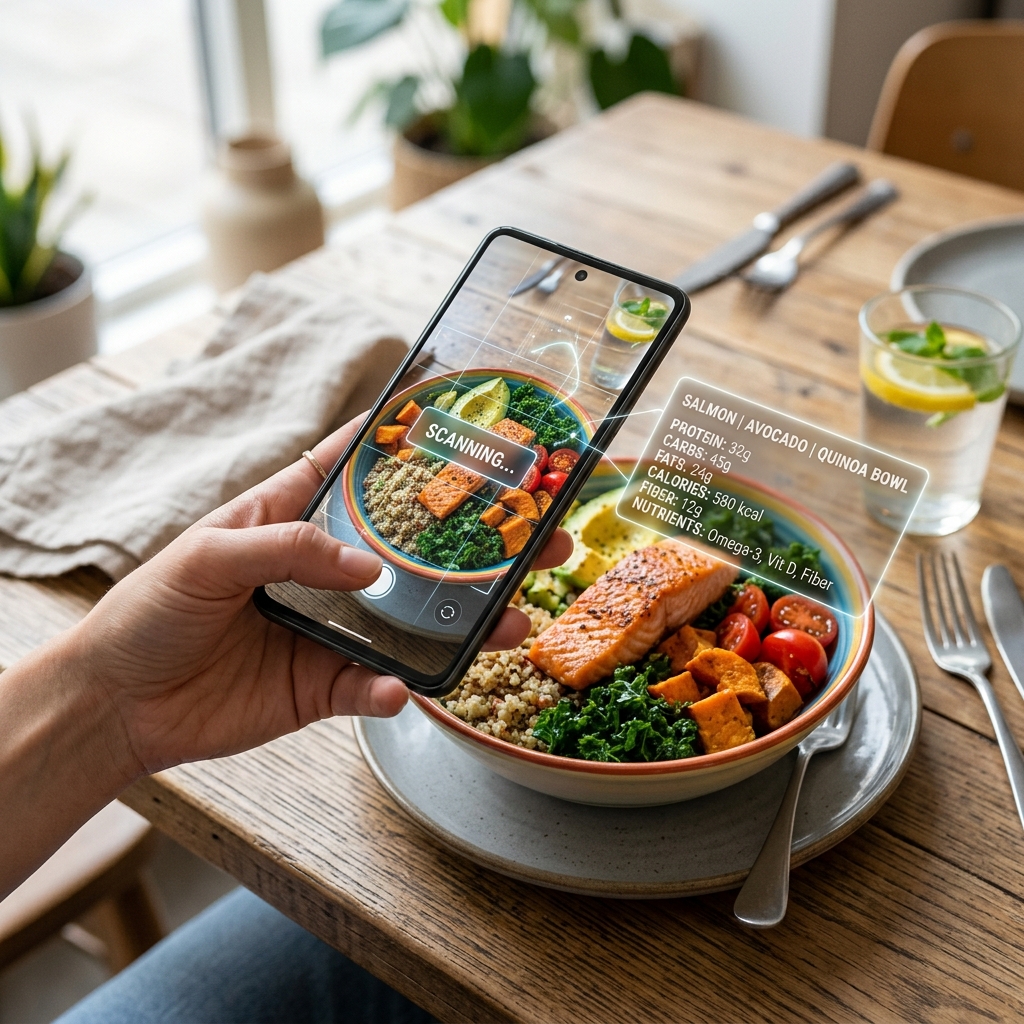
Whenever we explain **Nutraize** to a serious fitness enthusiast, the response is almost always identical: *“Sure, visual food scanning sounds convenient. But is a computer's photo estimate really accurate enough to keep me in a strict deficit?”*
It's a valid concern. When your goals depend on maintaining a calculated caloric deficit or hit target protein levels, wild guesses are useless. To answer the skepticism, we need to take a scientific look at how AI visual portion estimation stacks up against human manual logging.
1. The Elephant in the Room: Dieter Skepticism
Many people believe that unless they place every single food container on a calibrated scale, they are not truly tracking. They view visual AI as a "gimmick" for casual users rather than a serious utility.
However, this point of view assumes that manual tracking is inherently highly precise and that visual AI is merely a basic heuristic. Both assumptions are mathematically incorrect.
2. The Brutal Truth About Human Manual Logging
Multiple medical and behavioral studies have shown that **humans are notoriously terrible at estimating portion sizes.**
On average, active dieters **under-report their daily calorie intake by 30% to 50%**. Even trained nutritionists under-report by roughly 10% to 15% when asked to eyeball portion sizes manually.
Why? Because human eyes struggle with volume (especially when hungry). We naturally underestimate high-calorie dense foods (like rice, butter, or nuts) and overestimate low-calorie volume foods (like salad greens). Manual logging is not a gold standard of precision; it is highly vulnerable to human bias and error.
3. The Science of AI Portion and Volume Estimation
Unlike a human eye, a visual AI doesn't "guess" calories. It calculates them using a systematic multi-step computer vision process:
- 3D Volume Mapping: By detecting plate edges, glass diameters, or standard silverware sizes, the AI reconstructs the 3D depth and surface area of the food pile.
- Semantic Classification: It identifies the food type to cross-reference density (e.g. knowing a cup of fluffy rice has a different density than a cup of thick gravy).
- Macro Synthesis: It applies established regional nutritional profiles to convert estimated volume to weight, and weight to calories/macros.
In controlled testing, Nutraize's visual engine achieves **over 92% portion estimation accuracy** compared to lab scale measurements. It is consistently more precise than a human eyeballing portion sizes.
4. The Math of Consistency vs. False Precision
To understand why visual AI is superior for real-world weight loss, let's examine the mathematics of consistency:
Scenario A (Strict Manual Scale):
You weigh everything with 99% precision. However, because it is extremely tedious, you only log 40% of your meals (you skip weekends, restaurant trips, and snacks).
System Efficiency: 99% × 40% = 39.6% effective tracking.
Scenario B (Frictionless AI visual):
You snap a quick photo with 90% portion precision. Because it takes under three seconds, you maintain a 98% logging streak—tracking every meal, snack, and dining out event.
System Efficiency: 90% × 98% = 88.2% effective tracking.
An 88% accurate caloric log gives your body a stable, highly consistent feedback loop. A 39% accurate log is completely useless for weight loss because the untracked meals hide massive, weight-stalling calorie gaps.
5. Handling Edge Cases: The AI+User Partnership
Are there times visual AI struggles? Yes. A camera cannot look "through" a thick, opaque pastry to see if it is filled with low-calorie fruit or high-calorie chocolate custard.
To solve this, Nutraize implements a **human-in-the-loop fallback**.
If your meal is highly customized, you can easily tap or voice-flag the photo with a single-word detail (e.g. "chocolate fill" or "cooked in olive oil"). The visual AI uses this context to immediately correct the calculation. By combining quick user context with optical portion mapping, system accuracy pushes close to a flawless 96%.
Join the Visual Tracking Era
Nutraize brings 92% lab-tested visual portion accuracy to your pocket. Ditch the food scales, lose the stress, and finally get the results you want.
